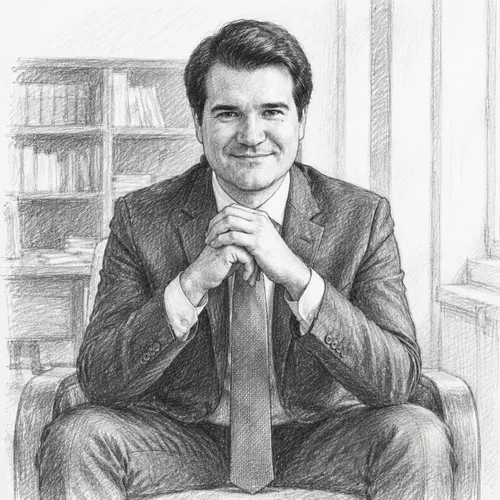
A 46-year-old math question, an AI model and a Waterloo professor
How a question from 1980 finally got its answer, and what working next to a mathematician taught me.



In 1980 a mathematician named W. Bucher asked a question about context-free languages. That's the family of languages that context-free grammars describe, the same kind of grammar used to define the syntax of most programming languages. Put roughly: take two of these languages, one sitting inside the other, with infinitely many words in the gap. Can you always fit a third one between them that leaves an infinite gap on both sides? Bucher showed the answer was yes for three other families of languages and left the context-free case open. Jeffrey Shallit, a computer science professor at the University of Waterloo, still listed it as an open problem in a talk in 2014.
It has an answer now, and the answer is no. The paper is Solution to Bucher's density problem for context-free languages, posted to arXiv on September 8, 2026, by Rastko Maslic (that's me, more on the name at the bottom) and Jeffrey Shallit. It's a preprint, so it's public and anyone can check it.
How it came together
I didn't do this at a chalkboard. I worked the problem with GPT 6 Astra, an AI model, and kept at it until it produced a proof. That proof was a diamond in the rough.
Then I took it to someone qualified to break it. Professor Shallit did the rest. He refined the proof and rewrote it so another mathematician could follow the argument without fighting it. He's the reason it reads like a paper and not a transcript.
Putting my original proof next to the final paper gave me a new respect for what mathematicians do. Professor Shallit's work was parsimonious. Steps that didn't need to be there came out, and the ones that stayed got clearer. The proof is easier to follow now, and easier to check. He distilled it to its essence.
The paper is upfront about where the ideas came from. Its Declaration of AI usage says most of them came from the model.
Getting them out still took patience. A model will hand you an answer that sounds finished long before it is, and the first confident answer is rarely the one you need. Staying on the problem, and never calling a result done until someone qualified had tried to break it, was most of my part.
Back to the day job
I try to bring the same patience and care to First AI Employee. An AI on your phone line can sound sure of itself long before it's right, so I build checks around it. When it writes a text reply, every price in it has to match a price you wrote yourself. If any number in that reply came from the AI instead of from you, the reply doesn't go out.
It's slower to build that way. For something that talks to your customers, I don't know another way I'd want to do it.
A note on the name: the paper lists me as Rastko Maslic, which is my birth name. Roscoe Morgan is the trade name I work under. Roscoe was my nickname in high school, and I use it because people can say it on the first try. Same person.
Roscoe
Pick First AI Employee in Google’s source settings and our answers surface more often when you search. One tap, and you can undo it any time.
Make us a preferred source